
Tax-Efficient Investment Strategies for HNI Investors in India

Ckredence Wealth |November 4, 2026

Tax-efficient investing for HNIs means controlling when gains are realised, how long assets are held, and whether losses get used. It does not mean finding a product that avoids tax. Most leakage comes from habits, not from the choice of scheme.
Picture a Surat textile promoter selling Rs 3 crore of shares to fund a new unit. Some positions are eleven months old, and some sit at a loss. This guide shows where tax leaks, how the Income-tax Act, 2025 treats gains and losses, and what a manager can do at stock level.
TL; DR
HNI tax leakage mostly comes from selling just before the 12-month line, leaving losses unused, and scattered statements.
From 1 April 2026, listed-equity gains are taxed at 20% (short-term) and 12.5% above Rs 1.25 lakh (long-term).
A short-term loss can be set off against any capital gain. A long-term loss only against long-term gains.
Unused capital losses carry forward for up to eight tax years, if the return is filed on time.
Harvesting a loss mostly defers tax, because the lower cost base raises the next gain.
In a PMS every sale creates a gain or loss in your name, and demat shares are matched first-in, first-out.
Check four numbers on last year's capital gains statement before changing anything.
Bring your current portfolio and last year's statements, and we will talk through them with you.
How Do HNI Investors in India Lose Money to Tax?
Three habits cause most of the leakage for HNI investors in India. Selling inside the first 12 months turns a long-term tax into a short-term one. Leaving losses unused and spreading holdings across separate statements finish the job.
According to the Income-tax Act, 2025, Section 196, short-term gains on STT-paid listed equity are taxed at 20%. Under Section 198, long-term gains above Rs 1.25 lakh in a year are taxed at 12.5% (as of 26 Oct 2026). Surcharge on these gains is capped at 15%, as reported on 1 July 2026.
📊 7.5 percentage points That is the gap between the short-term and long-term rates before surcharge and cess. On a Rs 10 lakh gain with the Rs 1.25 lakh exemption already used elsewhere, 20% is Rs 2,00,000 and 12.5% is Rs 1,25,000. The Rs 10 lakh is an illustration of the rule, not an expectation of any gain. Source: Income Tax Department, Sections 196 and 198, as of 26 Oct 2026 |
A diamond-trade family that books profits in the eleventh month often gives up the lower rate for no reason it would have chosen. Property-sale proceeds follow separate rules, covered in our capital gains guide for property sales.
How Does Tax Differ in a PMS and a Mutual Fund for HNI Investors?
In a mutual fund, tax arises when you redeem units, and trades inside the fund create no tax event for you. In a PMS, securities sit in your own demat account, so each sale by the manager creates a gain or loss in your name. A Surat promoter with a PMS and a fund book sees the PMS sales on his statement, but never the fund's internal trades.
| Equity mutual fund | PMS |
Holding | Units of a fund | Shares in your own demat account |
When tax arises | When you redeem or switch | On each sale the manager makes |
Stock-level loss | Stays inside the fund | Realised in your name, available for set-off |
Tax reporting | Follows your redemptions | Follows every trade |
One limit matters: demat shares are matched first-in, first-out, as CBDT Circular 768 explains. A manager therefore chooses which stock to sell and when, not which lot. Our guide to taxation on mutual funds and PMS covers each product's rules.
How Do Set-Off and Carry-Forward Rules Work for HNI Investors Under the Income-tax Act, 2025?
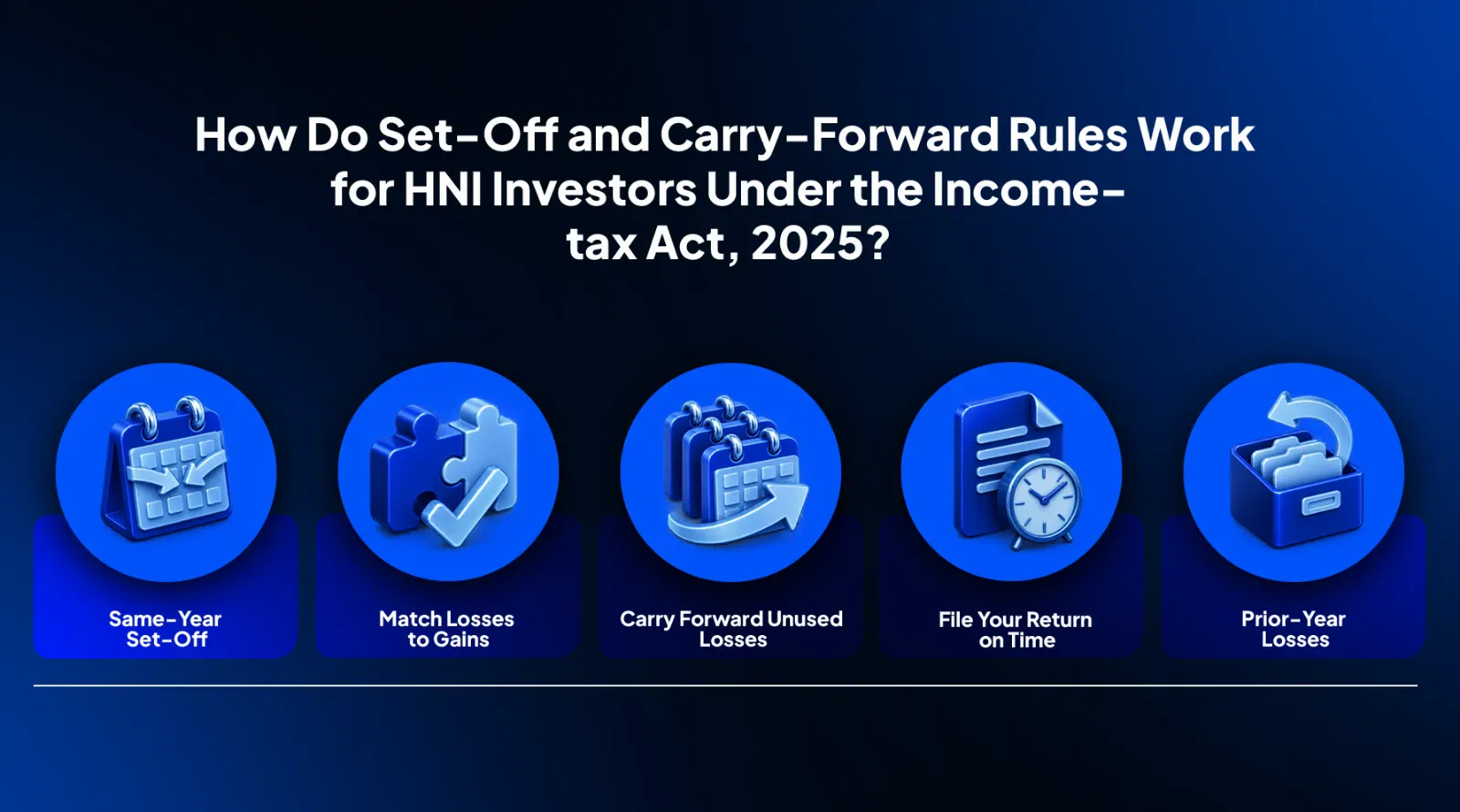
Capital losses can be set off only against capital gains. Under Section 108, a short-term loss can be set off against any other capital gain, and a long-term loss only against long-term gains. Section 111 carries an unused loss forward for up to eight tax years.
Set off within the tax year first. Losses meet gains of the same tax year before anything is carried forward.
Respect the character of the loss. A long-term loss cannot be set off against a short-term gain.
Carry the balance forward. The same character rules apply, for at most eight tax years.
File the return on time. Section 121 allows carry-forward only for a loss determined in a return filed under Section 263(1).
Treat older losses with care. Business Today, 13 Feb 2026 reports the final Act dropped a one-time relief from the draft Bill, so pre-April 2026 losses follow the old rules.
A post-liquidity founder holding both listed shares and AIF units should note that AIF taxation follows separate rules.
Does Tax-Loss Harvesting Really Save Tax for HNI Investors?
The assumption is that harvesting a loss saves tax. The reality is that it mostly defers tax. If you buy the same stock back, your cost base is lower, so the next gain is larger by the same amount.
The saving is real when a short-term loss absorbs a gain taxed at 20%, or when the loss is never repurchased. A retiring promoter who sold a plot this year may also have a long-term gain that a long-term share loss can absorb. Here is the tax value of a hypothetical Rs 5 lakh realised loss, at the 15% surcharge ceiling and 4% cess:
Short-term loss against a short-term gain: Rs 5,00,000 at 20% is Rs 1,00,000, or about Rs 1,19,600 with surcharge and cess.
Short-term loss against a long-term gain above Rs 1.25 lakh: Rs 5,00,000 at 12.5% is Rs 62,500, or about Rs 74,750.
Long-term loss against a short-term gain: nil this year, carried forward.
These figures show how set-off works. They are not a projection of any portfolio's gains or losses.
⚠️ Risk to understand Brokerage and STT apply on both the sale and the repurchase, and the price can move in between. We found no US-style wash-sale rule in the Act, but the general anti-avoidance rule can apply to arrangements without commercial substance. Ask your CA before repurchasing the same stock. |
Who presses the button matters too. In a discretionary PMS the manager decides sales, while in a non-discretionary mandate you approve each one.
Can You Find Your Tax Leaks in Five Minutes? The Four-Number Tax Leak Check
Open last year's capital gains statement from your broker, mutual fund houses and PMS. Find these four numbers, and none of them needs a calculator.
The number | Where to find it | What it tells you |
Short-term share of realised gains | Capital gains statement, short-term and long-term totals | How much was taxed at 20% instead of 12.5% |
Sales made in months 10 to 12 | Purchase and sale dates in the statement | Whether waiting past the 12-month line was possible |
Losses realised but unused | Statement against your filed return | Losses you paid for and did not set off or carry forward |
Number of statements | Count of PMS, fund house, broker and AIF statements | Whether anyone sees your combined position |
The pattern we see when a family brings us its statements is that the fourth number is usually the largest problem. Nobody has laid the PMS, the fund houses and the direct holdings on one page. Four numbers on one statement show where your tax leaked. For the wider picture, see our investment planning services for HNIs.
See your holdings on one page
A SEBI-registered advisory team can look at your PMS, funds and direct shares together, while your CA continues to file the return.
What Does a Year-End Tax Calendar Look Like for HNI Investors in India?
Under the Income-tax Act, 2025 the tax year runs from 1 April to 31 March. Spread the decisions across it.
April to June: Run the Four-Number Tax Leak Check on last year's statement and agree advance tax with your CA.
July to September: Note positions entering months 9 to 12 of holding, and file the return on time so any loss can carry forward.
October to December: List positions sitting at a loss and positions with large unrealised gains, sorted by holding period.
January to March: Decide any harvest. A sale must be executed on or before 31 March to fall in the tax year.
💡 For a post-liquidity founder A large gain realised in April leaves the whole year to find offsetting losses. The same gain realised in March leaves none. |
A PMS has no lock-in, so the timing of a redemption is your call. The PMS exit rules cover the exit fee and the notice process.
What Does Tax-Aware Management Look Like in a PMS or an RIA Mandate for HNIs?
A PMS can plan tax at stock level, because you own the shares and the manager decides the sales. Tax-aware advice comes from a SEBI-registered Investment Adviser, who looks at the whole picture while you place the orders. A founder who wants stock-level control and one who wants a second pair of eyes will choose differently, as our RIA vs PMS comparison shows.
Ckredence is neither a chartered accountant nor a tax practitioner, and it does not prepare or file returns. The tax position stays with you and your CA. Whichever route you pick, ask the manager in writing how tax enters its decision to sell.
Who Does Tax-Efficient Investing Not Help Among HNI Investors?
Tax planning adds little in four situations:
Realised gains under Rs 1.25 lakh a year: the long-term exemption on listed equity already covers them.
Income that is mostly interest: deposit and bond interest is taxed at slab rates, and harvesting does nothing for it.
A weak holding kept only to avoid tax: the tax is a cost, but a poor position can cost more.
NRI investors: withholding and treaty rules differ, and the NRI guide is the better starting point.
Data Sources & Methodology
Tax rules come from Sections 108, 111, 121, 196 and 198 of the Income-tax Act, 2025, as of 26 Oct 2026. CBDT Circular 768 covers demat matching. The surcharge cap and older losses come from mProfit (1 July 2026) and Business Today (13 Feb 2026).
Rupee figures are arithmetic to show how a rule works, not forecasts. Rules change, so confirm each point with your chartered accountant.
What Should an HNI Investor Do Next About Tax?
Run the Four-Number Tax Leak Check, then decide whether the problem is timing, unused losses or scattered holdings. A CA should confirm the fix before you sell anything.
Talk to our senior team about how your holdings are structured. There is no obligation.
FAQs
Can STCG be offset by LTCL?
No. A long-term capital loss can be set off only against long-term gains, while a short-term loss can be set off against either kind. An unused long-term loss carries forward for up to eight tax years.
Can capital losses be offset against capital gains?
Yes, against capital gains of the same tax year. Any unused balance carries forward if the return is filed on time. It cannot be set off against salary or business income.
How do I do tax-loss harvesting?
You sell a holding at a loss before the tax year ends, so the realised loss can be set off against capital gains. You then decide whether to repurchase. Check costs, the 12-month line and your CA's view first.
What are some effective tax planning strategies for high-net-worth individuals?
Common ones are holding listed equity beyond 12 months, setting off losses in the same year and bringing statements together. The right mix depends on your income and holdings, so agree it with your CA.